
Hyperboloid Contacts: The Core of Medical Connector Reliability
Learn how IEH hyperboloid contacts ensure reliable signal transmission and long-term performance in medical connectors for surgical robotics and life-saving devices.
Dec 19, 2025
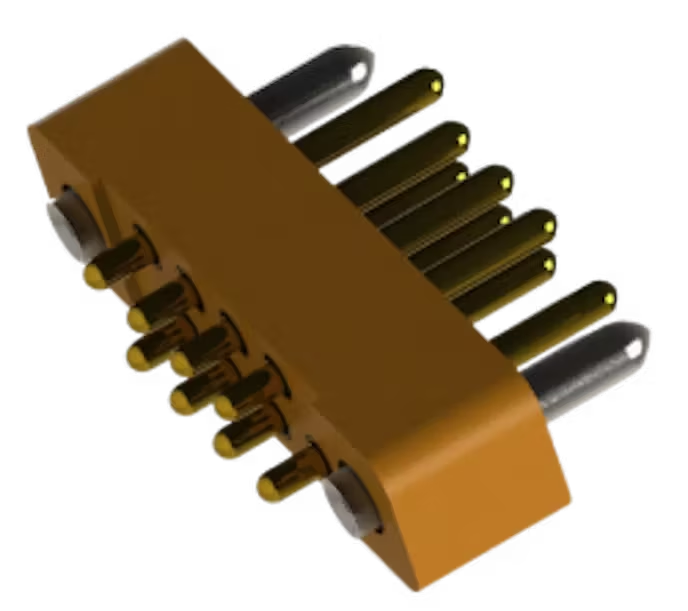
A Geometry That Changes Everything
Most conventional connectors rely on pin-and-tine socket contacts. Over time, these contacts wear down, lose conductivity, and require higher insertion force to maintain stability. By contrast, hyperboloid contacts use a unique structure of angled spring wires that cradle the mating pin. This design delivers:
- Multiple lines of contact for consistent electrical flow
- Low insertion force that reduces wear on both connector and device
- Uniform stress distribution that extends contact life
Instead of being a point of vulnerability, the connector becomes one of the most reliable parts of the system.
Why Medical Devices Benefit Most
The hyperboloid’s mechanical advantages align perfectly with the demands of medical equipment. In environments where devices may be plugged, unplugged, sterilized, and redeployed thousands of times, having a contact system that can endure hundreds of thousands of mating cycles without degradation is invaluable.
Why Signal Integrity Matters in Medical Applications
Reliability Equals Safety
Signal integrity is not just an engineering metric in healthcare but a matter of patient safety. A delayed signal in a robotic surgical arm, a corrupted image in an MRI scan, or a loss of data in a cardiac monitor could compromise care.
Hyperboloid contacts safeguard against these risks by:
- Preventing micro-arcing, which can distort or interrupt signals.
- Absorbing vibration and motion without breaking electrical continuity.
- Maintaining stable impedance for accurate, noise-free data transfer.
Applications That Depend on Signal Integrity
The variety of medical systems that rely on reliable connectors is vast:
- Surgical robotics connectors — enabling precision-controlled motion in minimally invasive procedures.
- Diagnostic imaging systems — transmitting high-resolution images without distortion.
- Defibrillators and monitoring devices — ensuring uninterrupted power and data flow in emergencies.
- Wearable and implantable technologies — where compact connectors must deliver flawless performance over long lifespans.
In each case, signal reliability is the invisible guarantee of patient safety.
Built for Sterilization and Longevity
Surviving Harsh Sterilization Protocols
Medical environments demand devices that can be sterilized and reused. But sterilization is punishing on materials:
- Steam autoclaving exposes equipment to high temperatures and humidity.
- Gamma irradiation breaks down polymers and coatings.
- Chemical sterilants like peracetic acid or ethylene oxide corrode metal surfaces.
Traditional connectors degrade under these conditions, suffering from pitting and oxidation or loss of spring force.
Hyperboloid contacts resist these failures thanks to their resilient design and durable material options. They continue to provide consistent conductivity even after hundreds of sterilization cycles.
Value Beyond the Operating Room
The benefits extend to both hospitals and OEMs:
- Reduced downtime: Devices last longer before needing service.
- Lower lifecycle costs: Fewer repairs and replacements save money.
- Improved trust: Physicians and patients can rely on equipment performance.
For OEMs, this longevity also strengthens the case for their devices in competitive healthcare markets.
Meeting the Demands of Miniaturization
Compact Without Compromise
The medical sector is rapidly moving toward smaller, less invasive devices. Catheter-delivered treatments, robotic-assisted procedures, and wearable diagnostics all require high-performance connectors in extremely compact footprints.
Hyperboloid contacts support miniaturization by:
- Allowing high-density pin counts in small form factors
- Maintaining reliable mating force even at reduced sizes
- Reducing insertion force, easing use in delicate instruments
Use Cases in Miniaturized Devices
- Catheter-based surgical instruments: where every millimeter of space counts.
- Wearable diagnostic tools: requiring lightweight, unobtrusive interconnects.
- Robotic surgical arms: combining high-density connectors with precision movement.
Miniaturization is only valuable if reliability is preserved, and hyperboloid contacts ensure no compromise between size and performance.
U.S.-Based Custom Engineering for Critical Applications
Why Off-the-Shelf Connectors Fall Short
Many medical devices have highly specific requirements that off-the-shelf connectors simply cannot meet. From sterilization compatibility to unique mechanical layouts, custom-engineered connectors are often the only option for OEMs developing next-generation solutions.
The IEH Advantage in Customization
IEH works directly with medical engineers to design connectors that address these challenges head-on. Advantages include:
- Precision engineering for exact dimensions and layouts
- Materials expertise to handle repeated sterilization
- Design flexibility to integrate into unique device architectures
And because IEH manufactures in the U.S., customers benefit from:
- Reliable supply chains with reduced geopolitical risk
- Rigorous quality control from design through production
- Responsive engineering support during every phase of development
For OEMs navigating regulatory pathways and production schedules, this level of partnership can be the difference between delay and success.
The Unsung Hero Behind Medical Innovation
Medical innovation is often measured in groundbreaking procedures, faster diagnoses, or improved patient outcomes. But behind those advances lies a chain of engineering decisions, none more critical than ensuring devices perform flawlessly under pressure.
The hyperboloid contact is the connector technology that makes this reliability possible. It enables:
- Reliable signal transmission in mission-critical applications
- Sterilization resilience across countless reprocessing cycles
- Longevity and durability that reduce costs and downtime
- Miniaturization without sacrificing safety or performance
For engineers and procurement teams designing the next generation of medical equipment, it’s not enough to meet minimum standards. Choosing the right connector technology ensures that life-saving devices live up to their promise every time they’re used.