
Inside the Connector: The Hidden Hero of Medical Device Performance
Discover how IEH hyperboloid contacts power reliable medical connectors, ensuring signal integrity, durability, and performance in life-saving devices.
Oct 23, 2025
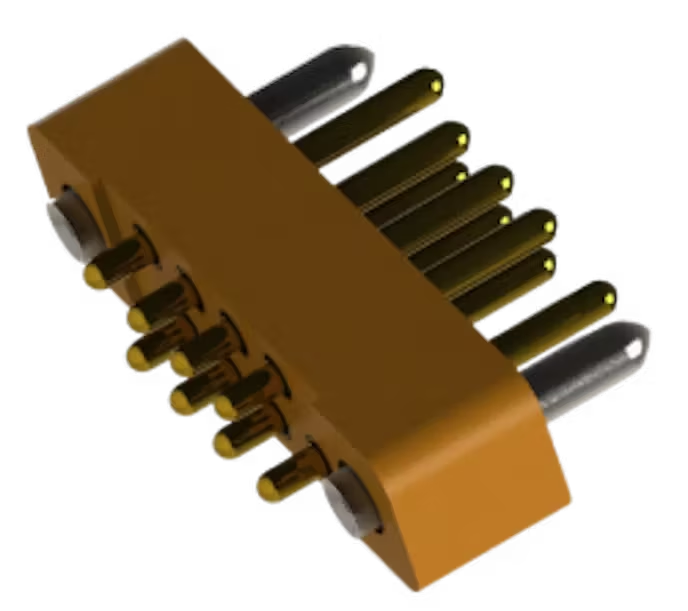
Inside the Connector: The Hidden Hero of Medical Device Performance
When most people picture a medical device, they see the outer technology. A robotic arm completing a precise movement or a monitor tracking a patient’s heart rhythm. Yet the reliability of those systems depends on something few people notice: the connector.
At the center of every connector is the contact system. This is where IEH brings unique value through the use of hyperboloid contacts. Unlike a simple pin-and-socket design that touches only a few points, the hyperboloid uses a lattice of fine wires that wrap around the pin to create continuous contact. This geometry distributes force evenly, lowers the effort required to mate, and ensures steady transmission of both signals and power.
For medical device engineers, this design difference is more than an academic detail. It determines whether a device can endure repeated sterilization and high-stakes clinical use while still performing after thousands of connection cycles.
Why Hyperboloid Contacts Define Reliable Medical Connectors
Medical environments impose challenges that are unique in the electronics world. Instruments must withstand frequent cleaning and unpredictable motion. They also need to operate reliably under heavy use. Traditional contact systems often fail under these conditions, either through mechanical wear or inconsistent conductivity.
How Standard Contacts Fall Short
- Pin-and-socket designs rely on a limited number of contact points. Small shifts in alignment or vibration can reduce conductivity.
- Higher mating forces wear out both the contact and the surrounding connector housing, shortening service life.
- Exposure to repeated sterilization cycles can fatigue the spring elements and cause loss of normal force.
How Hyperboloid Contacts Solve the Problem
- Multiple Points of Contact: The wire lattice maintains conductivity even if the pin shifts or vibrates.
- Lower Mating Force: Less stress on the connector reduces wear and extends life.
- Consistent Spring Action: The wires flex easily and return to shape, maintaining performance across thousands of sterilization cycles.
The result is a contact system that supports both precision and longevity.
Surgical Robotics Connectors
Few medical technologies push connector design as hard as surgical robotics. These systems bring together motion and high-density packaging while demanding strict reliability.
Precision Through Low Mating Force
Surgical instruments must be connected and disconnected many times. With conventional contacts, the repeated effort can wear down both sides of the interface. Hyperboloid contacts reduce that wear by requiring less force. Instruments can be sterilized and reset, then put back into use without connector degradation.
Smaller and Stronger Systems
Robotics demands compact components without loss of durability. Hyperboloid contacts support miniaturization while still providing strength and conductivity. This allows engineers to design robotic tools that are smaller yet equally capable.
Diagnostic Imaging and Signal Integrity
While robotics emphasizes motion, imaging systems emphasize clean data. MRI coils, ultrasound probes, and other diagnostic instruments depend on connectors that preserve signal clarity. Even small interruptions can distort results.
Why Signal Integrity Matters
Noise or loss in transmission creates unreliable images. For a patient, that may mean a repeat procedure or a missed diagnosis. For the OEM, it can mean a product that fails to meet clinical expectations.
Hyperboloid Advantages
The multiple contact points of the hyperboloid design reduce electrical noise and preserve stable signals. This consistency gives engineers confidence that imaging systems will perform as intended.
Wearable and Portable Medical Devices
The trend toward portability and patient mobility places new demands on connectors. Devices must be smaller, lighter, and more comfortable, yet still reliable.
Miniaturization Without Sacrifice
Hyperboloid contacts allow connectors to shrink in size while retaining strength. Patients can wear devices more easily, and engineers do not need to compromise on performance.
Endurance in Daily Use
Wearables and portables face both motion and bending, along with exposure to environmental conditions. Hyperboloid contacts flex with these demands while maintaining reliable connections.
Monitoring Equipment and Uptime
Continuous monitoring devices often run around the clock. A single connector failure can compromise patient safety.
- Hyperboloid contacts ensure uptime by maintaining conductivity during vibration and motion.
- The low wear rate extends service intervals, reducing the risk of unexpected downtime.
For procurement teams, these qualities reduce the total cost of ownership. Fewer replacements mean fewer maintenance interruptions.
Sterilization Durability
Every reusable medical device faces the same challenge: sterilization. Heat and chemicals can damage conventional contacts. Mechanical handling makes the problem worse over time.
Hyperboloid Performance in Harsh Cycles
The spring-like geometry of hyperboloid contacts resists fatigue. Even after thousands of autoclave or chemical cleaning cycles, they maintain shape and conductivity. This durability supports long service life and protects against sudden failure in clinical use.
U.S.-Based Manufacturing and Custom Engineering
IEH provides more than a proven contact design. Every step of production takes place in-house at U.S. facilities in Brooklyn, NY and Allentown, PA.
Why In-House Matters
- Faster Response: With design and tooling under one roof, IEH can move quickly from concept to prototype.
- Tighter Quality Control: Every step is monitored and verified, ensuring consistency across production runs.
- Custom Solutions: Many medical devices require unique connectors tailored to form, fit, and function. IEH engineers design around specific requirements rather than forcing OEMs to adapt to off-the-shelf parts.
This capability is why many OEMs choose IEH as a sole-source supplier. In a regulated environment where quality cannot be compromised, supplier reliability is as important as product reliability.
The Cost of Connector Failure
For device manufacturers, a failed connector is more than a technical issue. It can result in:
- Device downtime during a critical procedure
- Repeat sterilization cycles and extended turnaround
- Regulatory scrutiny or recalls
- Higher lifetime cost due to premature component replacement
By contrast, connectors built with hyperboloid contacts reduce these risks. They deliver stable performance over years of use, giving both engineers and clinicians confidence in the device.
The Hidden Hero Inside Every Device
Every medical breakthrough relies on unseen parts that work quietly in the background. Inside the connector, hyperboloid contacts preserve signal integrity and extend service life while enduring repeated sterilization.
In medical device design, reliability and patient safety are inseparable. The smallest component often carries the greatest responsibility. IEH continues to provide connectors that enable medical innovation to succeed under pressure.